Charitable solicitation registration compliance becomes more complex as nonprofits expand fundraising beyond a single state. This checklist is designed to help nationally fundraising organizations assess whether they have the foundational elements of a compliant, well-managed registration program in place.
Organizations that identify gaps often benefit from centralized oversight rather than state-by-state troubleshooting.
If your organization would like help reviewing its registration footprint, Ironwood Registrations can assist: contact us
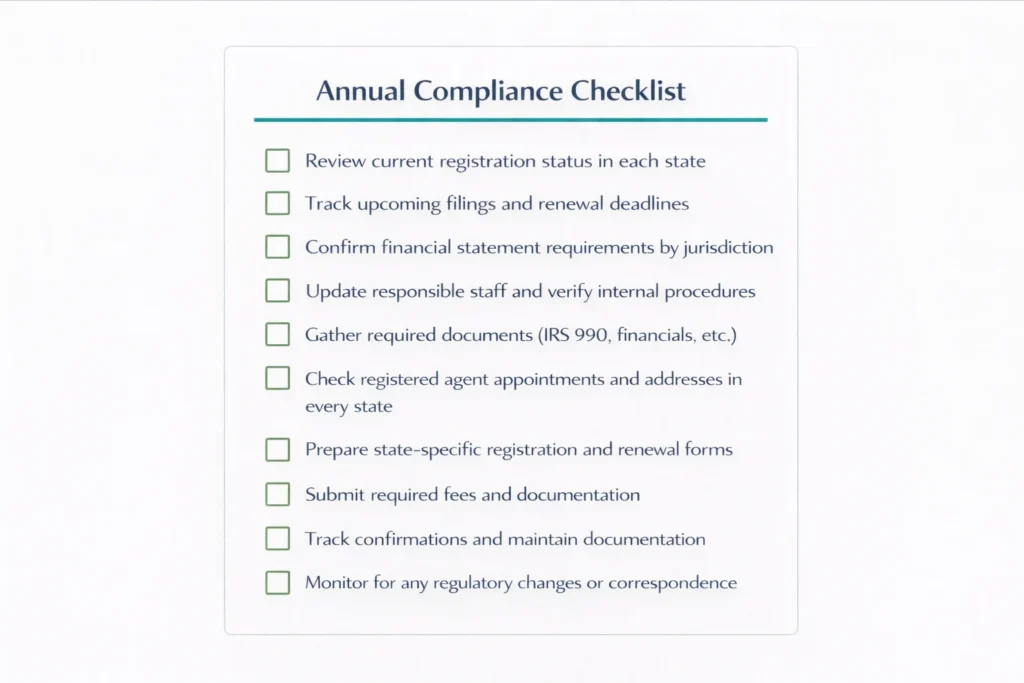
This is a short compliance checklist. For more details read below.
Step 1: Confirm Where Registration Is Required
Before filing anything, organizations should confirm where registration is actually required.
Checklist:
- ☐ Reviewed where donors are located
- ☐ Evaluated online fundraising activity (website, email, platforms)
- ☐ Identified states where solicitations are targeted
- ☐ Distinguished registration states from non-registration states
- ☐ Documented states where no filing is required
Helpful reference: How many states must nonprofits register in
Step 2: Verify Initial Registrations Are Complete
For each state where registration is required:
- ☐ Initial registration was filed before soliciting donations
- ☐ Registration status is active and in good standing
- ☐ State-specific disclosures were completed accurately
- ☐ Professional fundraiser relationships were disclosed (if applicable)
- ☐ Supporting documents were accepted by the state
State-by-state requirements vary significantly
Step 3: Track Renewal Deadlines and Filing Cycles
Renewals are one of the most common sources of compliance lapses.
Checklist:
- ☐ Renewal deadlines identified for each state
- ☐ Fiscal-year-based and anniversary-based deadlines tracked correctly
- ☐ Extension options documented where available
- ☐ Calendar reflects differing renewal cycles across states
- ☐ Responsibility for renewals is clearly assigned
Step 4: Align Financial Reporting and Audit Requirements
Many states impose escalating financial reporting requirements based on contributions, not total revenue.
Checklist:
- ☐ Contribution levels evaluated against state thresholds
- ☐ Audit or review requirements identified by state
- ☐ Audit timeline aligns with renewal deadlines
- ☐ IRS Form 990 consistency verified across filings
- ☐ Financial statements prepared early enough to avoid renewal delays
Organizations exceeding approximately $500,000 in contributions often encounter audit or review requirements in multiple states.
Step 5: Review Exemption Eligibility (If Applicable)
Exemption does not always mean “no filing required.”
Checklist:
- ☐ Exemption eligibility evaluated by state
- ☐ Required exemption filings submitted where applicable
- ☐ Supporting documentation retained
- ☐ Exemption renewal requirements tracked
- ☐ Volunteer-only fundraising assumptions verified
Exemption rules vary widely by jurisdiction
Step 6: Evaluate Online Fundraising Exposure
Online fundraising often expands registration obligations faster than expected.
Checklist:
- ☐ Donation-enabled website reviewed
- ☐ Email and digital campaigns evaluated by geography
- ☐ Recurring donation programs assessed
- ☐ Fundraising platforms reviewed for state exposure
- ☐ Donor follow-up practices considered
Step 7: Document Compliance Decisions
Documentation matters—especially during audits and due diligence.
Checklist:
- ☐ Registration determinations documented
- ☐ Non-registration decisions supported with rationale
- ☐ Renewal confirmations retained
- ☐ Correspondence with regulators archived
- ☐ Central record maintained for all states
Clear documentation reduces disruption during audits, grant reviews, and leadership transitions.
Step 8: Determine Whether Centralized Management Is Needed
Organizations often benefit from centralized oversight when:
- ☐ Fundraising occurs in many states
- ☐ Multiple renewal cycles are active
- ☐ Financial thresholds differ by state
- ☐ Internal teams spend excessive time tracking compliance
- ☐ Risk exposure is unclear
At this stage, outsourcing coordination often reduces administrative burden and risk.
Multi-state compliance overview
Choosing a charitable solicitation registration service
How Ironwood Registrations Helps
Ironwood Registrations supports national nonprofits by:
- Assessing where registration is required
- Coordinating initial filings and renewals
- Tracking deadlines, extensions, and thresholds
- Aligning financial reporting with state requirements
- Maintaining audit-ready documentation
Schedule a consultation to review your checklist results
Or contact our team directly
Related Resources
How Many States Does My Nonprofit Need to Register In?
Charitable Solicitation Registration Mistakes That Put Nonprofits at Risk