A practical overview of managing registrations and renewals across multiple states.
Executive Overview
As nonprofit organizations expand fundraising activities across multiple jurisdictions, charitable solicitation registration requirements often become an ongoing operational responsibility rather than a one-time compliance task. While many organizations initially register in only a few states, growth in digital fundraising, national campaigns, and donor outreach frequently results in complex multi-state obligations.
For established nonprofits, the challenge is rarely understanding that registration is required. Instead, the difficulty lies in maintaining consistent compliance across dozens of jurisdictions, each with distinct renewal cycles, documentation standards, and financial reporting thresholds.
This guide outlines the operational realities of managing charitable solicitation registrations at scale, common compliance risks encountered by mature organizations, and practical considerations for maintaining continuity as fundraising programs evolve.
Who This Guide Is Intended For
- Multi-state fundraising organizations
- Finance and operations leaders
- Development teams managing national campaigns
- Organizations already registered in multiple states
1. The Role of Charitable Solicitation Registration in Multi-State Fundraising
Charitable solicitation registration is a state-level regulatory framework intended to promote transparency and accountability in charitable fundraising. Most states require nonprofits to register before soliciting contributions from residents, regardless of where the organization is physically located. Registration affects the ability to continue fundraising activities without delay.
Activities that commonly trigger registration obligations include:
- Online donation campaigns accessible nationwide
- Email and direct mail fundraising
- Grant solicitations directed to residents of a state
- Peer-to-peer or platform-based fundraising
- National marketing or awareness campaigns
For established nonprofits, registration becomes less about initial approval and more about maintaining continuous eligibility to fundraise without interruption.
2. When Registration Obligations Expand
Organizations often transition into multi-state compliance gradually. Expansion typically occurs when fundraising practices outpace internal tracking systems.
Common expansion triggers include:
- Growth in digital fundraising platforms
- Increased national visibility
- Corporate partnerships spanning multiple regions
- Board-driven expansion initiatives
- Mergers or program integration with other organizations
Because registration requirements differ significantly among states, expansion can introduce overlapping deadlines, varying documentation expectations, and evolving financial statement requirements.
3. Operational Challenges Established Nonprofits Encounter
Organizations already registered in multiple states frequently encounter operational—not legal—difficulties.
Staggered Renewal Cycles
Unlike federal filings, charitable registrations renew throughout the year. Managing dozens of independent deadlines can strain internal administrative resources.
Institutional Knowledge Loss
Compliance processes are often maintained by a small number of staff members. Turnover or role transitions can disrupt tracking systems and historical continuity.
Regulator Correspondence
States may request clarifications, amendments, or additional documentation. Monitoring and responding consistently across jurisdictions requires centralized oversight.
Documentation Variability
States request similar information but in different formats, including governing documents, financial statements, contracts, and disclosure language.
Financial Threshold Monitoring
Audit and review requirements vary widely and may change as revenue grows, requiring ongoing monitoring rather than annual review.
Fragmented ownership
Often there is a disconnect between the development team and the finance team about who is responsible for what part of fundraising compliance.
4. The Multi-State Registration Management Lifecycle
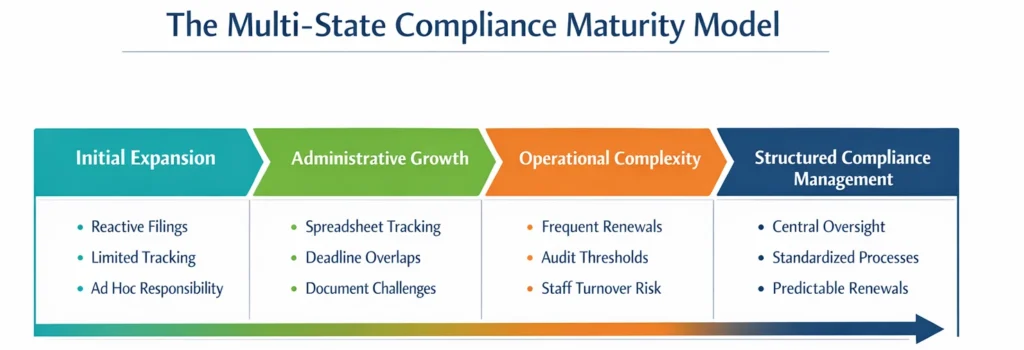
As nonprofits expand fundraising activities, charitable solicitation registration often evolves from an initial filing requirement into an ongoing operational responsibility. While each organization’s experience differs, most move through similar stages as registration obligations grow. The framework below outlines common patterns observed in multi-state compliance management.
Compliance Management Models Comparison
| Management Approach | Primary Strength | Operational Limitations | Best Suited For | Typical Organizational Stage |
|---|---|---|---|---|
| Internal Administration | Direct organizational control and familiarity with internal processes | Requires significant staff time; knowledge concentrated in individuals; tracking complexity increases as states grow | Organizations registered in a limited number of jurisdictions | Stage 1–2 (Initial Expansion / Administrative Growth) |
| Legal Counsel Oversight | Strong regulatory interpretation and support during complex or enforcement matters | Ongoing renewal tracking and administrative coordination may fall outside standard legal workflows | Organizations needing regulatory interpretation or issue resolution | Situational use across all stages |
| Specialized Registration Management | Centralized tracking, standardized filings, and continuous renewal oversight | Requires external coordination and onboarding of historical records | Organizations managing multi-state fundraising on an ongoing basis | Stage 3–4 (Operational Complexity / Structured Management) |
Stage 1 — Initial Expansion
Organizations begin registering in additional states as fundraising expands beyond their home jurisdiction.
Typical characteristics:
- reactive registrations
- limited tracking systems
- decentralized responsibility
Typical Warning Signs
- Registrations are initiated only after fundraising activity has already begun in a state.
- Responsibility for filings is informal or unclear.
- Registration decisions are made campaign-by-campaign rather than through a defined policy.
- Leadership assumes compliance requirements remain similar across states.
- Documentation is gathered repeatedly because no centralized record exists.
Stage 2 — Administrative Growth
Registration volume increases and renewal cycles become staggered.
Common developments:
- spreadsheets or calendar tracking
- growing documentation requirements
- increasing regulator correspondence
Typical Warning Signs
- Deadlines tracked in spreadsheets or individual calendars maintained by different staff members.
- Renewal notices arrive from states unexpectedly.
- Increasing time spent locating prior filings or attachments.
- Multiple versions of governing documents or financial statements circulate internally.
- Staff begin expressing uncertainty about where registrations are active.
Stage 3 — Operational Complexity
Organizations manage numerous jurisdictions simultaneously.
Challenges often include:
- audit threshold monitoring
- staff turnover risk
- inconsistent historical filings
Typical Warning Signs
- Renewals cluster unexpectedly throughout the year, creating workload spikes.
- Audit or financial review requirements emerge without advance planning.
- Regulator correspondence is routed through multiple departments before resolution.
- Institutional knowledge resides with one or two individuals.
- Leadership learns of compliance issues only when a deadline is approaching.
Stage 4 — Structured Compliance Management
Registration becomes an ongoing operational function supported by defined processes and centralized oversight.
Outcomes:
- predictable renewals
- reduced compliance risk
- improved fundraising continuity
Indicators of Transition Into Structured Management.
- Organization recognizes compliance as an ongoing operational function rather than a periodic task.
- Standardized processes begin replacing ad hoc tracking.
- Centralized visibility into registration status is established.
- Renewal timelines become predictable.
- Compliance discussions shift from reaction to planning.
Common operational models organizations use to manage multi-state charitable solicitation compliance.
5. Financial Statements and Audit Threshold Management
Many states condition registration or renewal requirements on an organization’s contribution revenue or total financial activity. As organizations grow, reporting expectations often change.
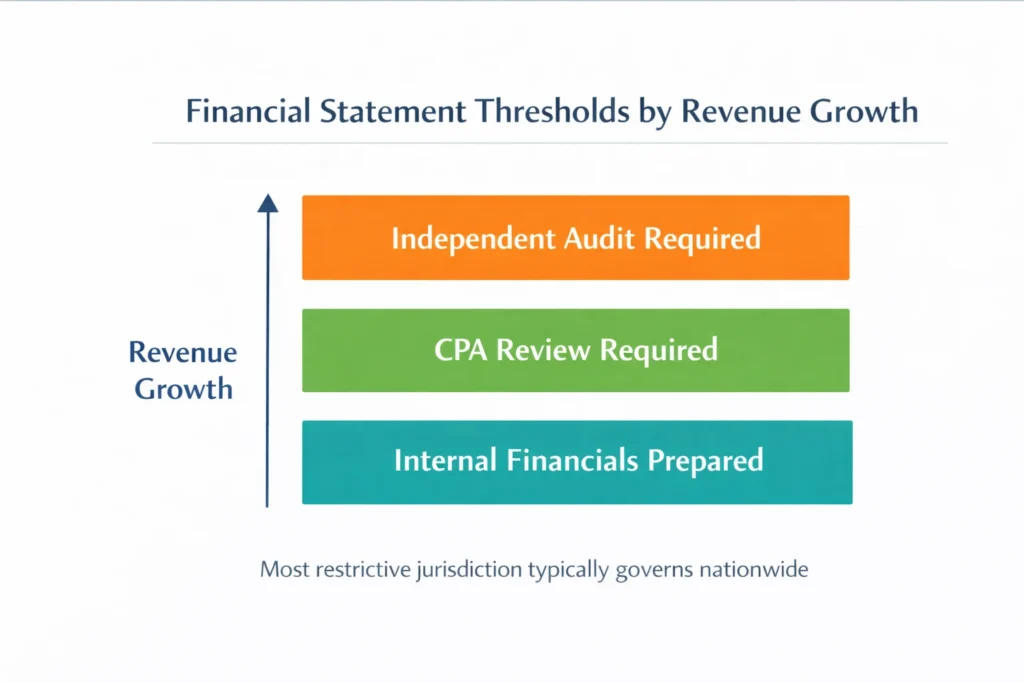
Common thresholds include:
- Internally prepared financial statements
- CPA reviews
- Independent audits
Because financial statement thresholds differ by jurisdiction, organizations fundraising nationwide often must comply with the most restrictive applicable requirement to maintain consistency across filings.
Failure to anticipate threshold changes can delay renewals or require corrective submissions. This complexity increases because states apply differing thresholds and may measure financial activity using different reporting metrics.
6. Common Compliance Risks in Mature Programs
Established nonprofits rarely experience compliance issues due to misunderstanding regulations. More often, challenges arise from operational complexity.
Frequent risk areas include:
- Assuming prior compliance continues automatically
- Expanding fundraising before registrations are updated
- Missed renewals during organizational restructuring
- Inconsistent disclosure language across campaigns
- Delayed responses to regulator inquiries
These risks typically emerge gradually and may remain unnoticed until a renewal delay or regulatory inquiry occurs.
Compliance Drift
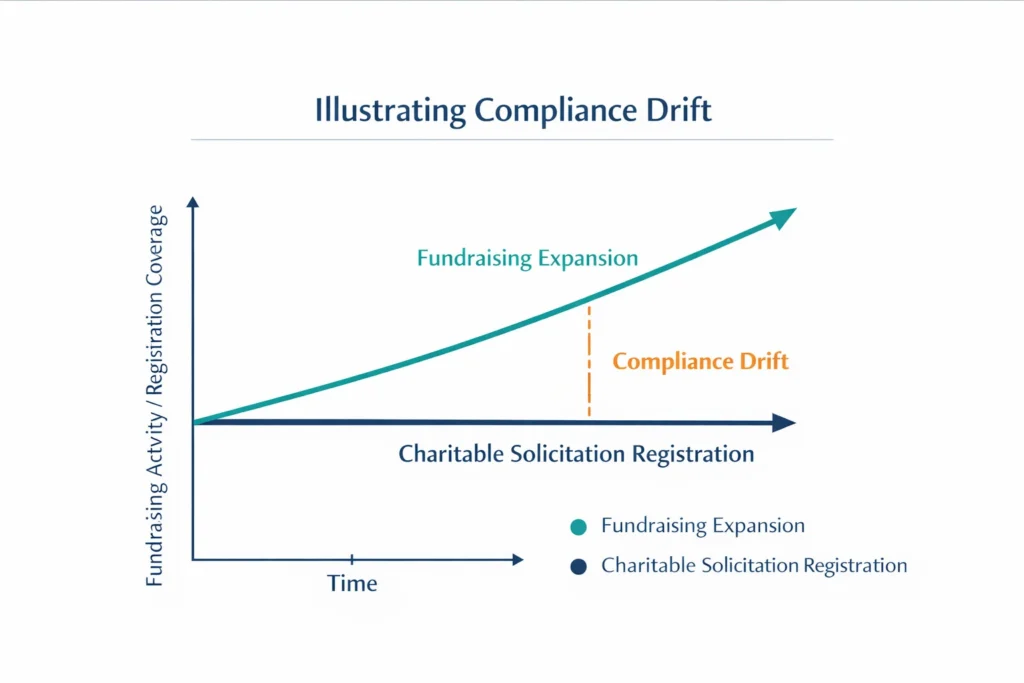
In many mature fundraising programs, compliance challenges do not arise from misunderstanding regulatory requirements but from gradual operational misalignment. As fundraising methods expand—through new platforms, campaigns, or geographic outreach—registration coverage may remain based on earlier organizational activity. Over time, filings, disclosure language, and renewal assumptions can fall out of sync with current fundraising practices. This gradual separation between operational reality and registration status is often unnoticed until a renewal delay, regulator inquiry, or internal review occurs. Because the change is incremental, organizations may remain unaware that risk has accumulated.
7. Approaches Organizations Use to Manage Registrations
Nonprofits employ several models to manage charitable solicitation compliance.
Internal Administration
Some organizations track deadlines internally using spreadsheets or calendar systems. This approach can work effectively for smaller registration footprints but becomes more demanding as jurisdictions increase.
Best suited for organizations registered in limited jurisdictions.
Legal Counsel Oversight
Law firms may assist with filings or complex regulatory interpretation. However, ongoing renewal administration may fall outside typical legal workflows.
Best suited for interpretation or enforcement matters.
Specialized Registration Management
Some organizations utilize providers focused exclusively on charitable solicitation filings, renewal tracking, and regulator coordination.
| Model | Strength | Limitation | Best Fit |
|---|---|---|---|
| Internal | Control | Resource strain | Few states |
| Legal Counsel | Interpretation | Not operational | Complex issues |
| Specialized Management | Continuity | External coordination | Multi-state programs |
Best suited for ongoing multi-state renewal administration.
Each model reflects different operational priorities, staffing capacity, and risk tolerance.
8. Evaluating Registration Management Support
Organizations reviewing their current compliance approach often consider operational factors rather than regulatory interpretation alone.
Important considerations include:
- Centralized deadline tracking
- Consistent preparation standards
- Responsiveness to regulator correspondence
- Continuity despite staff turnover
- Clear communication regarding filing status
Predictability and transparency are frequently as important as technical accuracy.
Operational Outcomes Organizations Often Seek:
- Greater confidence that fundraising activities can proceed without interruption.
- Predictable renewal cycles that reduce last-minute administrative work.
- Clear visibility into registration status across all jurisdictions.
- Reduced dependence on individual staff knowledge or manual tracking.
- Faster and more consistent responses to regulator inquiries.
- Improved coordination between finance, development, and leadership teams.
- Fewer unexpected compliance escalations requiring urgent attention.
- Increased organizational confidence when expanding fundraising initiatives.
9. Transitioning from Existing Processes or Providers
Established nonprofits occasionally reassess registration management following organizational growth, internal restructuring, or service challenges.
Common transition concerns include:
- Maintaining uninterrupted registrations
- Preserving institutional filing history
- Avoiding duplicate submissions
- Coordinating renewal timing during transition
Careful onboarding and documentation review typically allow transitions to occur without disruption when managed systematically.
10. Practical Compliance Checklist
Organizations managing multi-state fundraising may benefit from periodic review of the following:
- Current registration status by state
- Upcoming renewal deadlines
- Financial statement thresholds
- Disclosure language consistency
- Responsibility assignments for regulator correspondence
- Documentation storage and accessibility

Regular review reduces the likelihood of reactive compliance management.
Some organizations periodically conduct an external status review to confirm registrations remain current across jurisdictions.
11. Frequently Asked Questions
Do all states require charitable solicitation registration?
No. Requirements vary, and several states maintain exemptions or limited oversight structures.
Does online fundraising create nationwide obligations?
In many cases, yes. Online accessibility can trigger registration expectations depending on solicitation activity.
Are registrations permanent once approved?
Most states require annual or periodic renewal to maintain active status.
Do audit requirements apply uniformly across states?
No. Financial thresholds differ and may change as organizational revenue grows.
Conclusion
For established nonprofits, charitable solicitation registration is less a legal hurdle than an ongoing operational responsibility. As fundraising programs expand, maintaining consistent multi-state compliance requires structured tracking, documentation management, and proactive oversight.
Organizations that treat registration as a continuous administrative function—rather than a periodic project—are better positioned to avoid interruptions and maintain fundraising continuity across jurisdictions.
Organizations that implement structured registration management early typically experience fewer disruptions as fundraising expands.
Optional Next Step
Organizations that would like additional clarity on their current registration status may benefit from an independent review.
Ironwood Registrations offers a complimentary multi-state registration status audit that identifies where registrations are active, where renewals may be approaching, and whether any gaps or issues are visible based on publicly available state records.
If helpful, we are always available to discuss findings or answer questions about managing ongoing compliance obligations.